The New Rules of Kitchen Cabinet Design: What's Actually Worth Installing in 2026
What's Actually Driving Kitchen Cabinet Design in 2026
The kitchen cabinet industry doesn't move in straight lines. Trends emerge from a convergence of material availability, cultural shifts, and the way people actually use their kitchens — not just how they photograph them. In 2026, that convergence has produced a set of directions that feel both fresh and durable.
This isn't a list of fleeting aesthetics. These are structural shifts in how homeowners and designers think about custom cabinets for kitchen spaces — and why they matter for long-term satisfaction.

Inset Doors Are Replacing Overlay as the Premium Standard
For decades, full-overlay cabinet doors dominated remodels because they were faster to install and more forgiving of minor framing inconsistencies. That's changing. Inset doors — where the door sits flush within the cabinet frame — have become the defining mark of custom craftsmanship in high-end kitchens.
The appeal is architectural. Inset cabinetry creates a surface that reads as furniture, not as millwork. The shadow lines, the precision of the reveal, the way the door sits perfectly contained — these details signal quality in a way that overlay simply cannot replicate.
The tradeoff is tolerance. Inset doors require frame squareness and humidity-stable materials. This is precisely where working with an experienced manufacturer matters. Brands with deep production infrastructure — like Goldenhome, a global custom cabinetry manufacturer with over 27 years of experience — are equipped to hold these tolerances consistently across production runs.
Two-Tone Layouts Have Matured
The two-tone kitchen — upper cabinets in one color, lowers in another — peaked in interior blogs around 2021. What's happened since is more interesting: the approach has matured from a trend into a legitimate design principle.
The current execution is more restrained. Designers are pairing:
- Warm white uppers with deep sage or slate lowers
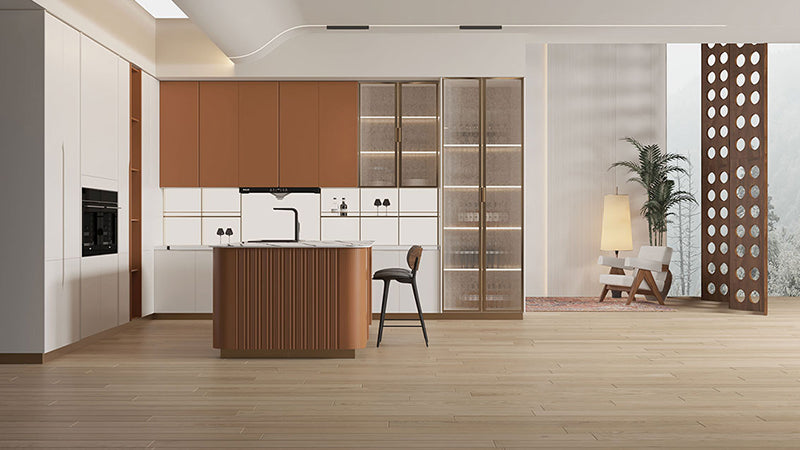
- Natural oak veneer islands against painted perimeter cabinetry
- Matte black accents on otherwise neutral custom cabinets for kitchen perimeters
The goal isn't contrast for its own sake — it's zoning. Different materials and tones define cooking areas, storage areas, and social zones within the same kitchen footprint.
Handleless Design: Functional, Not Just Minimal
Push-to-open mechanisms and integrated aluminum finger pulls have moved from European niche to mainstream American kitchens. The reason isn't purely aesthetic. Handleless cabinets offer genuine functional advantages in high-traffic kitchen environments: no hardware to snag clothing, easier cleaning, and a cleaner visual field that makes smaller kitchens feel larger.
The more sophisticated version of this trend uses routed grip channels integrated directly into the door face — a detail that requires precise millwork but ages beautifully as hardware trends come and go.
Warm Tones Are Displacing the All-White Kitchen
The all-white kitchen is not disappearing, but it is no longer the default aspiration. Material palettes in 2026 lean warmer: greige lacquers, limewash-effect finishes, natural oak and walnut veneers, and warm-toned hardware in brushed brass or unlacquered bronze.
This shift is partly generational — younger homeowners associate sterile white kitchens with a certain era of staging and flipping — and partly practical. Warm tones hide wear better, read as more inviting on camera, and hold their appeal longer than trend-driven brights.
For custom kitchen cabinets, this means finish specification has become more complex. The variance between a matte greige and a satin greige in the same color family is significant under different lighting conditions — something worth discussing carefully with your manufacturer before finalizing.
Floor-to-Ceiling Storage Is Being Designed, Not Retrofitted
One of the clearest signals of a custom cabinet approach versus a semi-custom one is how vertical space is handled. In spec kitchens, wall cabinets stop at a standard height and the gap to the ceiling becomes a dust-collecting shelf or a display area by default.
In genuinely custom kitchens, the cabinet design starts from the ceiling down. Tall pantry columns, integrated appliance towers, and stacked upper configurations that run wall-to-wall create a built-in architectural effect that dramatically changes how a kitchen reads — and how much it can store.
This approach requires early coordination with your contractor, since ceiling height, soffit placement, and lighting all need to be accounted for before cabinet dimensions are finalized.

The Japandi Influence on Custom Kitchen Cabinetry
The Japandi aesthetic — a blend of Japanese minimalism and Scandinavian functionalism — has had a sustained influence on kitchen cabinet design. Its core principles translate directly into specification decisions:
- Natural grain wood with minimal finishing (not stained to obscure, but treated to reveal)
- Hardware in matte black, dark bronze, or none at all
- Concealed storage that reduces visual clutter
- Proportions that emphasize horizontal lines over vertical stacking
The Japandi kitchen isn't sparse — it's organized. The difference lies in how storage is designed: every item has a designated place, and the cabinet layout is built around actual usage patterns rather than a standard module grid.
What These Trends Share
The common thread across every direction above is intentionality. The kitchens gaining the most attention in 2026 aren't following a checklist — they're making considered decisions about materials, proportion, and function that hold up beyond the current moment.
Custom cabinets for kitchen spaces are uniquely positioned to deliver that kind of result, because the specification process forces exactly those conversations. The trend becomes secondary to the question of what actually works in your kitchen, for your household, for the long term.
That's the design shift worth paying attention to.